SOC 2 in 2026: Why Enterprise Buyers Want More Than an Audit Report
A SOC 2 report is already out of date the day it’s signed off. Not because anyone made a mistake, but because the environment it describes keeps moving anyway. A new SaaS tool gets connected before security is looped in. A firewall rule opened during an incident never gets closed back up. An employee leaves, and their access stays active a few weeks longer than it should.
None of this is misconduct. It’s ordinary IT operations. But each of these changes touches a control the report already signed off on, which means the report’s picture of the environment starts going stale the moment work continues as normal. That gap, between what was tested and what’s actually running now, is what SOC 2 in 2026 is really about.
What the Report Actually Proves, and Where That Assurance Stops
Type I: Proof of Design in Time
A Type I report checks whether the right controls were designed and put in place as of a specific date. It’s a check on control design at one moment, not on how those controls behave over time.
Type II: Proof the Design Actually Worked
A Type II report goes further. It tests whether those same controls actually operated effectively across a defined observation period, the core of what SOC 2 Type II is meant to prove, giving assurance on SOC 2 operating effectiveness during that window, not just at one point.
Both: Proof That Expires the Day the Window Closes
A Type II report only accounts for the window it examined, nothing before it and nothing after. Once that window closes, the report stops speaking for the environment, even though the environment keeps operating: new access gets granted, new systems get added, new vendors get connected. That ongoing operation is exactly what neither report type was built to track, and it’s the actual subject of everything that follows.
Why Growing Third-Party Risk Outpaced What the Report Covers
Third-party risk is the actual reason a SOC 2 report alone no longer settles a buyer’s concerns in 2026. Vendor standards have tightened at the same time vendor-related breaches have grown, and both trends point the same direction.
ISC2’s Supply Chain Risk Survey, published November 2025, which polled more than a thousand cybersecurity professionals, found that 77 percent of organizations now name compliance with standards like ISO 27001, NIST, or SOC 2 as their top requirement when evaluating a vendor. In financial services, that climbs to 84 percent.
The exposure behind that scrutiny is real. Verizon’s 2026 Data Breach Investigations Report found that third-party involvement in breaches jumped to 48 percent, up 60 percent from the year before. That’s a broad measure of how often a third party played some role in a breach, not a claim that vendors caused half of all breaches, but the direction is unmistakable.
Buyers are demanding more proof of vendor controls right as their exposure to those same vendors keeps climbing, and that’s not a coincidence. A report only speaks for a period that’s already closed. What buyers actually want is confidence that the controls behind your report are still working today, not just that they were tested once.
How Provisioning, Access, and Config Changes Create Control Drift
Control drift isn’t usually a governance failure. It’s a side effect of routine provisioning and access work: a cloud resource gets spun up ahead of a project deadline, an admin’s privileges get widened temporarily to close a ticket faster and never get scoped back down, a vendor’s integration goes live before its security review finishes, or an application migration carries a legacy configuration forward because nobody re-validated it against the new environment.
Each of these changes quietly shifts something an auditor will eventually check: who has access, how a system is configured, what the actual security posture looks like, and which dependencies now exist that didn’t before. Once that’s happened, the questions that come up during a review are predictable: who approved this, what exactly changed, did anyone review it, and was the access removed once it was no longer needed?
Much of this drift is really configuration drift, a narrower, more specific version of the same problem: a firewall rule gets added, a permission gets widened, a policy gets relaxed under pressure during an incident. None of it is malicious. But without an accurate, current inventory of what exists, who can reach it, and what changed recently, none of it gets caught before an auditor finds it first which is exactly the risk SOC 2 in 2026 is pushing enterprises to close.
The IT Systems Behind Every Piece of SOC 2 Evidence
The evidence doesn’t come from a GRC platform. It comes from the systems that were already running the business, IAM, monitoring tools, ITSM, backup infrastructure. A GRC platform just aggregates what those systems already produced, it can’t generate evidence for a control that isn’t actually operating.
Here’s what that actually looks like, control by control:
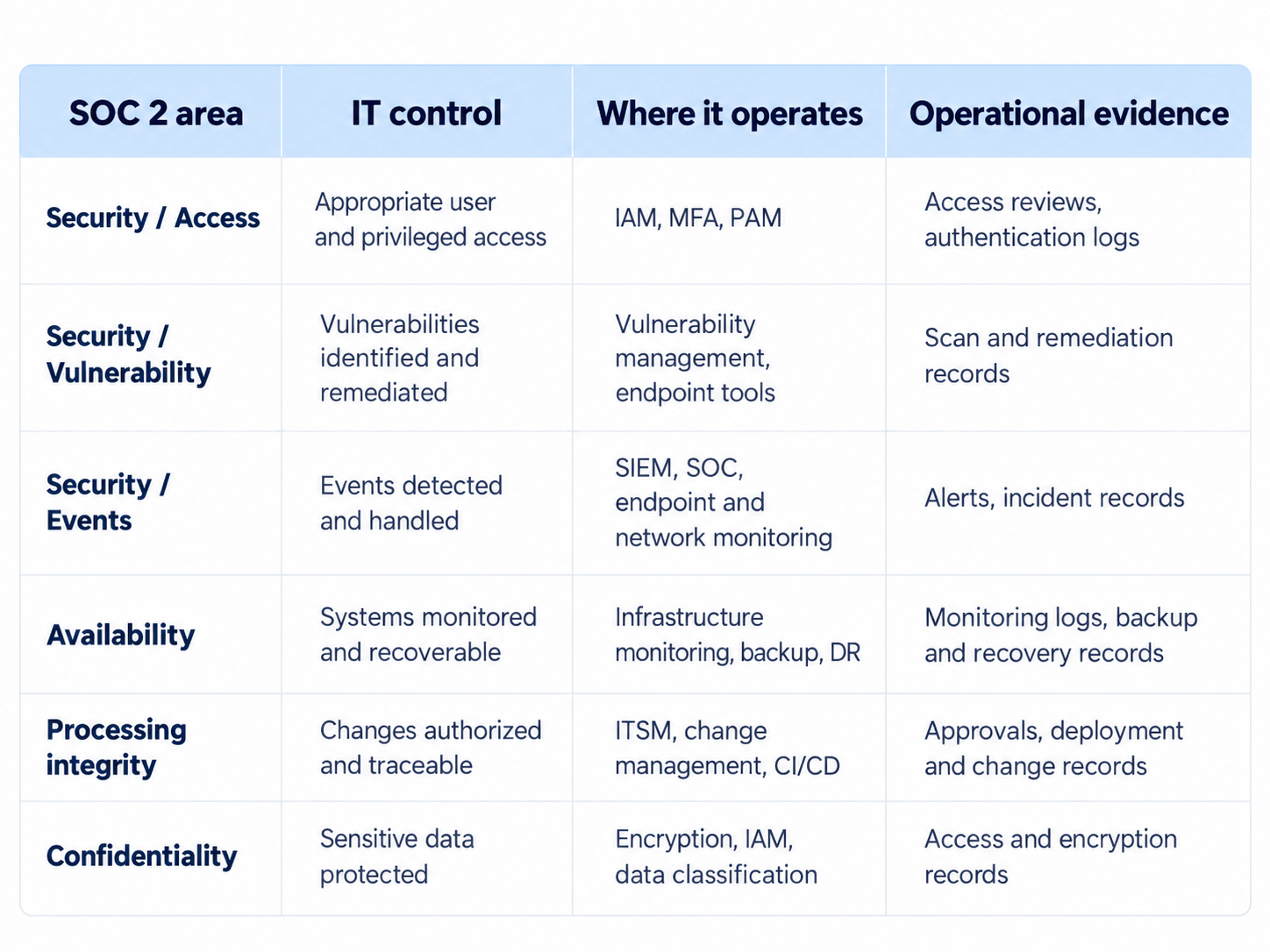
CC9.2 adds a related layer that isn’t one of the five Trust Services Criteria above, but it still needs its own evidence trail. It covers vendor access and risk, operating through vendor management, IAM, and cloud or SaaS inventory tools, and it shows up as assessments, reviews, and access records, the same kind of proof as everything else in the table, just for third parties instead of internal systems.
Detecting an Event Isn’t the Same as Proving Control Compliance
Knowing which system produces a control’s evidence only tells you where to look. It doesn’t tell you whether that evidence actually proves anything once the system starts generating activity, which is where monitoring and compliance quietly get treated as the same thing when, operationally, they answer different questions.
More Dashboards Don’t Mean Better Compliance
More visibility isn’t the same as more assurance. A dashboard can show a hundred events a day and still tell you nothing about whether the organization is actually compliant, because seeing an event and doing something correct about it are two different achievements.
The Four Steps That Actually Make Up Compliance
Four separate things have to happen, in order, for an event to actually count as compliance evidence:
- Monitoring – shows what happened
- Response – shows what IT did about it
- Control – shows whether that response followed the required process
- Evidence – shows whether any of that can be demonstrated afterward
Evidence Is a Byproduct, Not a Deliverable
The goal was never to produce more evidence. It’s to run identity, monitoring, and change management well enough that SOC 2 audit evidence is simply a record of work that was already happening, generated automatically by the tools doing that work, not a folder someone assembles the week before the audit starts.
A Log Only Counts as Evidence If It Shows the Control Working
A well-formatted activity log isn’t proof of anything by itself. It only becomes evidence when it shows the specific control operating exactly as designed, an access review that actually happened, a patch that was actually applied, not just a system that was capable of producing one.
The Access Drift Problem Behind SOC 2 Vendor Risk (CC9.2)
CC9.2 covers how organizations assess and manage risk from vendors and business partners: onboarding, access approval, ongoing monitoring, reassessment, and offboarding.
The real problem isn’t the number of vendors an enterprise works with. It’s the number of access paths, integrations, data flows, and dependencies each relationship quietly creates. The World Economic Forum’s Global Cybersecurity Outlook 2026, published with Accenture, found that 65 percent of large companies now name third-party and supply chain vulnerabilities as their single greatest resilience challenge, up from 54 percent just a year earlier. Yet only 33 percent of organizations say they comprehensively map their own supply chain ecosystem, which means most of them are managing risk they can’t actually see.
A large enterprise typically runs hundreds of active technology and service relationships at once. An annual review captures what things looked like on the day it happened. It says nothing about what’s actually reachable inside the environment today, and the WEF data suggests most organizations wouldn’t be able to answer that question even if asked.
Something can still look approved in a procurement file while the admin accounts, API integrations, or production access tied to it have quietly changed underneath that approval. That’s a visibility gap in the technical sense, not a paperwork gap. It usually only gets caught once that management is tied to real IAM and infrastructure data, not a questionnaire sitting in a shared drive.
The IT Disciplines That Keep SOC 2 Evidence Audit-Ready
1. Identity
Every time someone joins, changes roles, or leaves the organization, their access should update automatically as part of that process, not as a separate compliance task. When privileged-access reviews run on the same rhythm, the access evidence already exists before anyone has to ask for it.
2. Vulnerability and patch management
Scan results, remediation records, and documented exceptions should come directly from the tools already scanning the environment, not from a spreadsheet assembled the week before fieldwork.
3. Change management
Every infrastructure or firewall change, including the ones made under pressure during an incident, needs an approval and validation trail. That’s exactly when drift tends to slip through unnoticed.
4. Monitoring and incident response
An alert only means something once it moves through investigation, escalation, remediation, and closure. One that’s acknowledged and then forgotten isn’t evidence of anything.
5. Vendor risk
A vendor inventory tied to actual system access, reviewed on a cadence that matches each vendor’s risk tier, tells IT more than a single annual check applied evenly across every vendor.
6. Backup and disaster recovery
A successful backup doesn’t prove recovery works. Recovery-test results, backup success records, and exception logs are what actually show recovery functioning, not just running on schedule.
A compliance platform can organize this evidence once it exists. It can’t compensate for missing access controls, unmanaged changes, weak monitoring, or vendor relationships nobody is tracking.
Fewer Gaps to Reconstruct, Lower the Audit Cost
The real question for SOC 2 in 2026 was never which control needs more evidence. It’s which systems, identity, monitoring, change management, vendor access, backup, already generate that evidence as a normal part of running, and which ones only produce it when someone remembers to go looking.
That second group, the disciplines still running on manual effort, is usually where the real audit risk concentrates, and it’s typically smaller than most IT leaders expect: one or two areas, often vendor risk or privileged access, where evidence still depends on someone remembering to pull a report rather than a system generating it automatically. Closing that gap doesn’t require replacing what’s already working. It usually means extending the same automated evidence-generation that already exists in identity or monitoring to the one or two disciplines that haven’t caught up yet.
That’s really what separates a smooth audit from a scramble. Not more tooling, not a bigger compliance team, just fewer places where the evidence has to be reconstructed instead of simply pulled from something that was already running.
This is usually the point where a managed IT and security provider adds real value, not by running the audit itself, but by closing the operational gaps in the systems the audit depends on. Progression works with enterprises on exactly this layer, including security monitoring and SIEM and backup and recovery, so the evidence a SOC 2 report eventually asks for already exists, generated by IT operations built to run this way from the start, rather than assembled in the month before an audit.
FAQs
- Is our SOC 2 Type II report still enough to close enterprise deals in 2026? Not on its own. A Type II report proves controls worked during a set period, but buyers increasingly want confidence those same controls are still working today. The report opens the conversation; ongoing evidence of control effectiveness is what actually satisfies procurement now.
- Why do our buyers keep asking for proof beyond the report we already give them? Because the report only covers a period that’s already closed. Buyers know your environment kept changing after that, so they’re asking for confidence that access, monitoring, and vendor controls are still operating the way the report described, not just that they once did.
- How do we know if our controls are still working after our audit period ends? You need evidence generated continuously, not reconstructed before the next audit. If access reviews, change approvals, and monitoring alerts happen automatically as part of daily operations, you already have proof. If they only happen before fieldwork, you don’t.
- Does CC9.2 mean we need to reassess every vendor more often than once a year? Not on a fixed schedule, CC9.2 doesn’t set one. But it does require knowing what each vendor can access right now, not just what they could access at your last review. High-access vendors typically need more frequent checks than low-risk ones.
- How much continuous monitoring do we actually need to stay SOC 2 ready? Enough that access, configuration, and vendor changes get flagged as they happen, not discovered during fieldwork. Monitoring alone isn’t compliance, it still needs a documented response, but it’s what feeds the evidence trail auditors expect to see across the full period.
