Surviving a Cloud Region Outage: Managed Hosting vs Hyperscalers
A cloud region outage can stop your applications for hours, and your customers will not care whose data centre failed. What happens to your business depends on the architecture you chose, the agreement you signed and how often cloud disaster recovery is tested. Whether you run on a hyperscaler or on managed cloud hosting, someone must own the recovery, and that has to be decided before the outage.
On 20 October 2026, an external cable fault cut one of the two power supplies feeding a Google Cloud data centre in London, and the backup generators did not start. Google’s report says the power loss hit one availability zone, yet the disruption reached beyond it. A setup that looks safe on paper, an agreement that says little about who acts first and a failover nobody has tried can turn one power fault into a long outage.
Why One Failed Dependency Can Turn Into a Cloud Region Outage
In both recent incidents, the first thing to fail was not an application server. It was something the applications depended on.
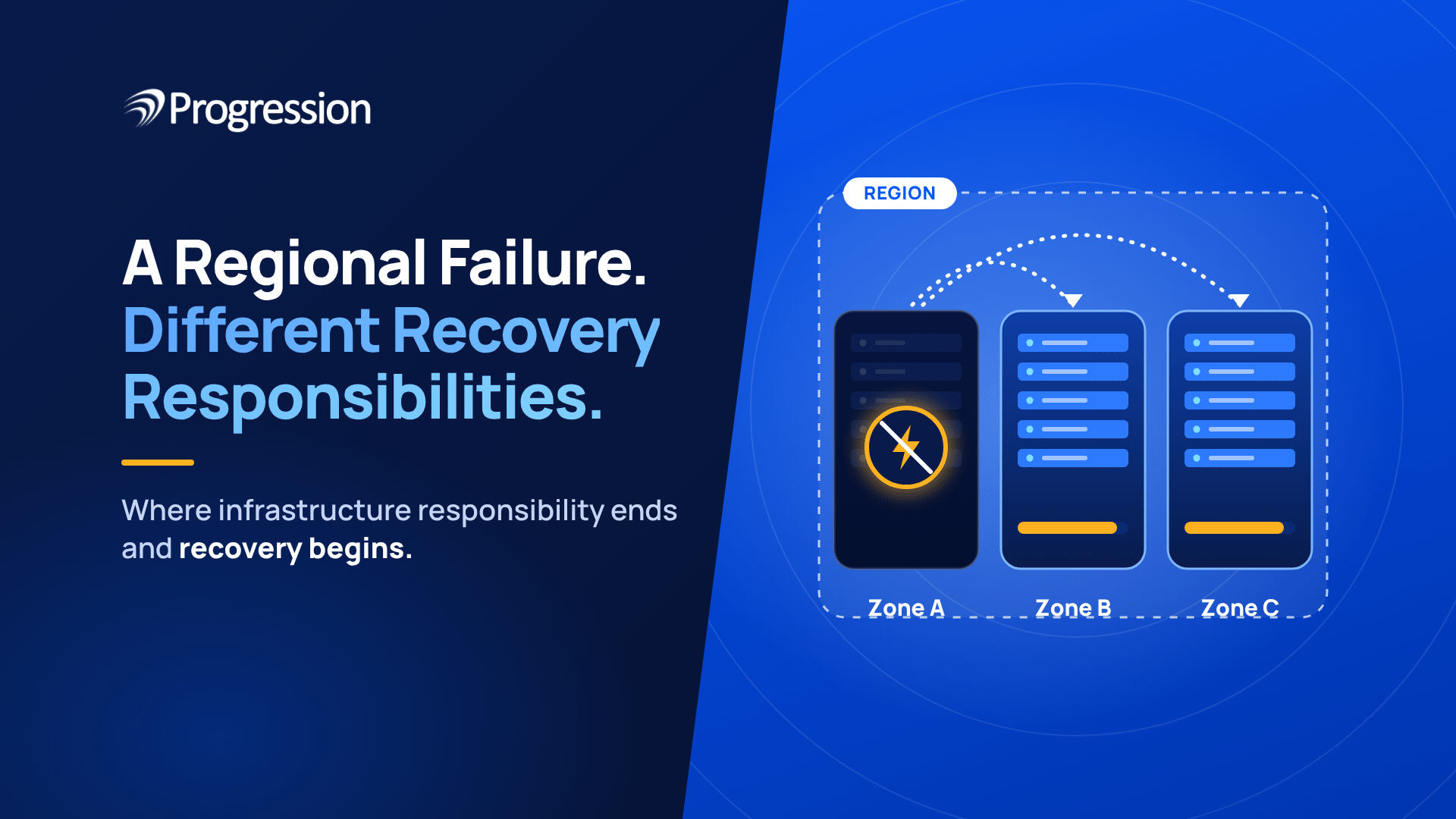
The Wider Impact of Google’s London Power Failure
Google’s incident report shows a site that was already exposed. After problems in a generator test on 14 October, one power supply was disconnected for repairs, so London ran on a single supply. When the cable fault cut it, the generator controls checked for voltage upstream of the open breaker, found it and never started the generators. The batteries lasted about five minutes and the zone went offline, with the main impact lasting 6 hours and 8 minutes.
The other London zones kept power but took the load. Failovers and redirected traffic used up spare capacity, and some regional services timed out reaching management components in the affected zone. Architecture and testing decided this outcome: one power supply, and a control that never checked the breaker.
The Ripple Effect of AWS’s DynamoDB DNS Failure
DNS turns a service name into a server address. In October 2025, a flaw in the automation behind DynamoDB’s DNS left its regional address empty, so applications could not find it. AWS’s post-event summary shows that DynamoDB recovered early on 20 October, yet new EC2 launches kept failing until the afternoon. The whole event lasted about 14 hours and 32 minutes. Servers that were already running stayed healthy.
So in a recovery plan, existing servers can be fine while you still cannot add capacity. A failover test should include creating new resources.
The Limits of Multi-Zone Cloud Protection
Multiple zones protect you from losing one location, but these shared dependencies can still fail together.
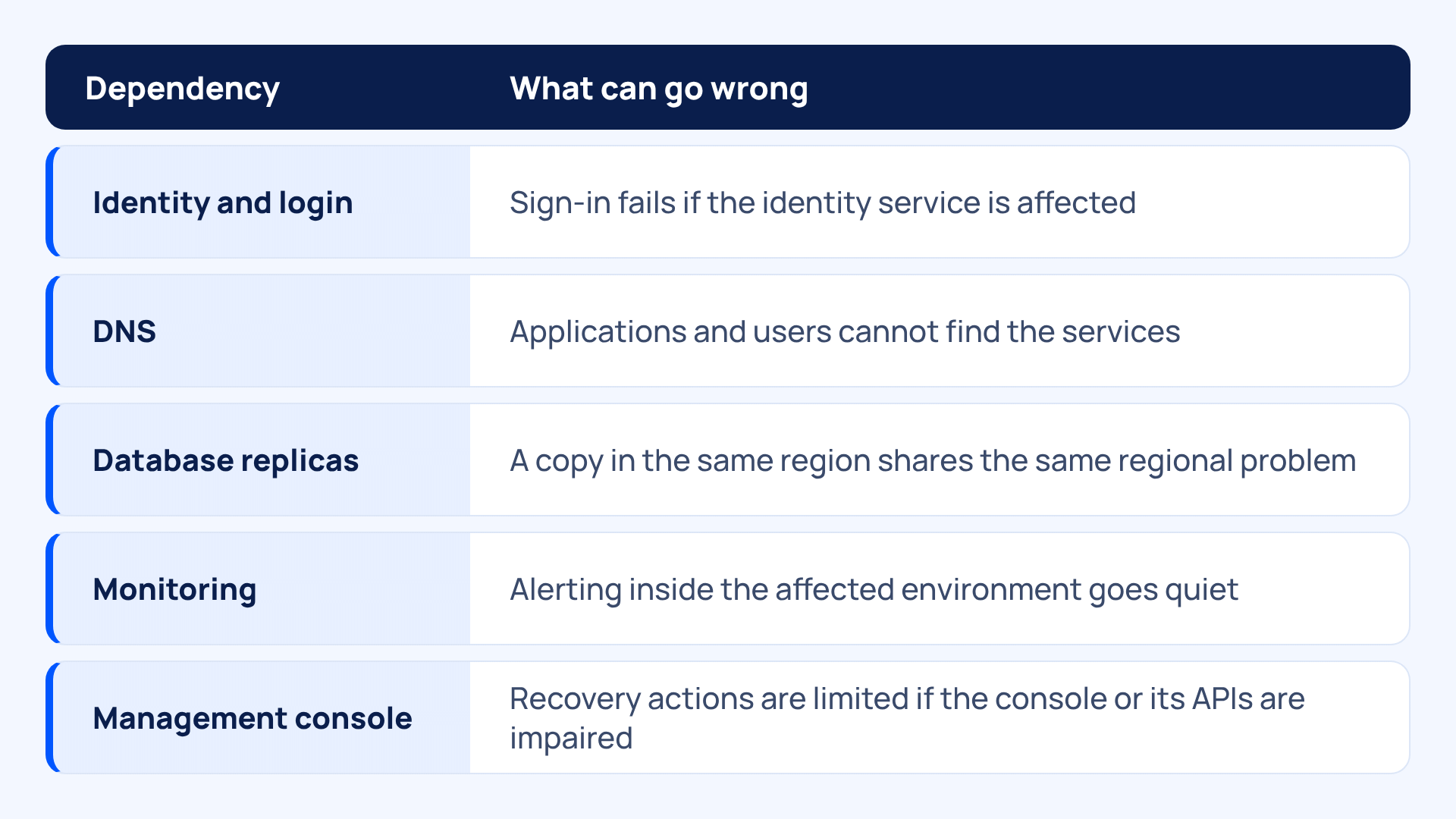
Not every item is regional, so check how each one is set up. Our post on cloud hosting reliability shows how these gaps appear during an outage. Fixing them needs an owner, and that is where the choice between a hyperscaler and managed hosting starts to matter.
Managed Cloud Hosting vs Hyperscalers: What Happens When Systems Go Down
The two models overlap more than they sound. Hyperscalers sell recovery tools, many companies hire a partner to run their AWS or Azure setup, and some managed hosts use third-party data centres. What matters is who manages the environment and which recovery tasks your agreement includes.
Cloud Service Credits Do Not Guarantee Application Recovery
A service-level agreement (SLA) is a provider’s written promise about one service, and the remedy if it misses. People often mix up four things:
- Uptime commitment: the availability promised for a named service.
- Service credit: the remedy if that promise is missed.
- Application recovery: how fast your application returns. Who designs and tests it depends on what each party agreed.
- Business continuity: keeping essential operations running. This stays with your organisation, even when providers run the infrastructure.
The AWS EC2 SLA commits to 99.99% for instances across two or more availability zones, with a 10% credit if uptime falls below that but stays at or above 99.0%. Google’s Compute Engine SLA calls its credit the customer’s sole and exclusive remedy.
Turning Managed Hosting into a Clear Recovery Commitment
With managed cloud hosting, the provider handles the tasks in your contract, such as monitoring, backups and failover. Application recovery is not automatic, so check whether the commitment covers only servers or the whole application. Put two numbers in writing: the recovery time objective (RTO), which is how long a system can stay down, and the recovery point objective (RPO), which is how much recent data you can lose. The business sets them from the cost of downtime, and the provider commits to what it can deliver.
Before signing, ask where the recovery site is, who starts failover and approves the move back, and when recovery was last tested. Also ask what happens if the provider’s own data centre or network fails.
A Side-by-Side View of Cloud Recovery Responsibilities
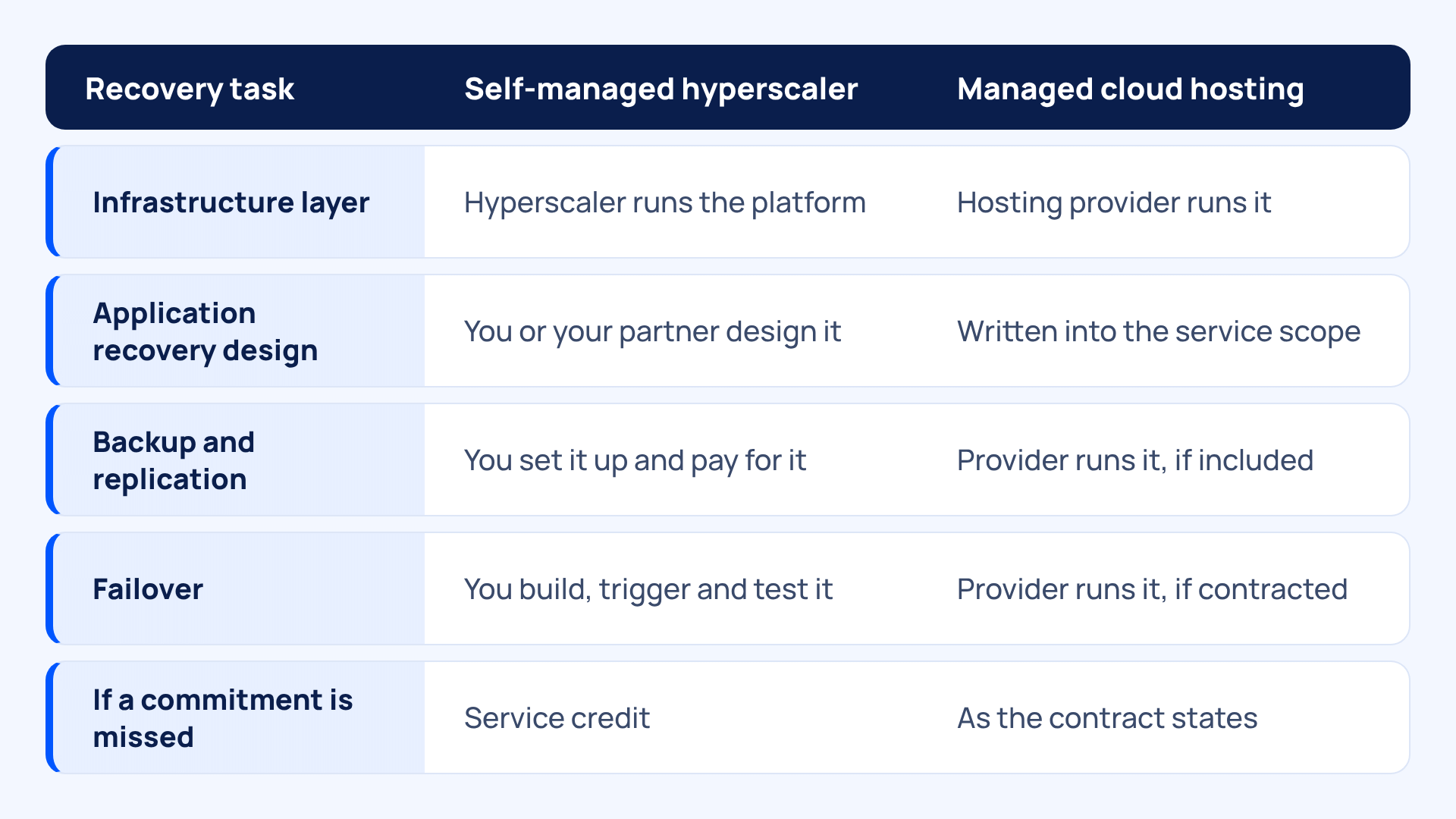
In both models, the business sets its own recovery targets, and what the provider agrees to do shapes what recovery costs.
What Cloud Disaster Recovery Costs, and What Downtime Can Cost
Cloud disaster recovery costs depend mostly on how much of the recovery site you keep ready. There are three common ways to do it:
- Backup and restore: data copies are kept and systems are rebuilt after a failure. It costs least and takes longest.
- Warm standby: a smaller running copy is ready to scale up. Recovery is faster, with ongoing running costs.
- Active-active: two environments run together. Interruption is lower, but it needs the most infrastructure and testing.
Some providers offer these models as disaster recovery as a service, where replication and failover are set up ahead of time and recovery is tested in regular drills. Running in more than one region also adds replication and egress charges, which are fees for moving data out of a service or location. Managed hosting usually has a fixed monthly fee, so budgeting is easier, but check that the recovery site, data transfer and failover tests are in the price. Once the budget is clear, the next question is where to recover, because the location must meet the data and regulatory rules for your workload.
Data Rules That Decide Where Your Cloud Disaster Recovery Can Run
Rules on where data can be stored and processed vary by industry, regulation and type of data, and they decide which recovery locations are open to you.
For banks and certain NBFCs, the RBI’s 2023 IT outsourcing directions expect providers to keep business continuity and disaster recovery plans that are tested regularly, including for a provider’s exit. The responsibility stays with the regulated entity, and the directions don’t fix one RTO, RPO or testing interval, so your compliance team should confirm which rules apply to you.
The directions also refer to storing data in India where existing requirements call for it, which is not a blanket India-only rule. AWS runs two regions in India, Mumbai and Hyderabad, so an in-country pair is possible. Before choosing the second region, confirm that the databases, storage and backup tools your application uses are available there.
Some workloads have to stay in one place, while others need to scale fast. That is why many businesses mix managed private cloud with public cloud.
Where a Hybrid Cloud Strategy Helps and Where It Falls Short
Putting some workloads on managed private cloud and others on a hyperscaler can reduce reliance on one environment, but only if the two are really independent. If they share identity, DNS, network links or backup services, those become common points of failure, as in the earlier table. Cloud infrastructure resilience comes from checking those shared pieces, not only from where the servers sit.
Workloads That May Suit Managed Hosting
Systems with strict data-location rules, steady demand and a need for a named recovery owner, such as core banking and ERP, may suit managed hosting. They can run in public cloud too, so decide on regulation, architecture, cost and the recovery contract.
Workloads That May Suit Hyperscalers
Applications with sudden traffic swings, short-lived test environments and analytics bursts suit a hyperscaler, which adds capacity quickly.
A mixed setup only works if each workload’s recovery has been tested, and that is where preparation starts.
How to Prepare for a Cloud Region Outage
Most teams find their weak spots during an outage, which is the worst time to find them. These steps help you find them earlier. Failover means moving a workload to a backup environment when the main one fails, and a recovery site proves nothing until an application has run from it.
- Map dependencies. List what each critical application needs (login, DNS, databases, network links, monitoring) and where it runs. Both incidents above started with a dependency, not a server. This is where disaster recovery planning starts.
- Agree RTO and RPO. Ask each application owner how long they can be down and how much recent data they can lose.
- Test one application first. Record the real recovery time and data loss against those targets.
- Check that people can work. Users should be able to log in, finish key tasks and reach connected payment, ERP and reporting systems.
- Create new servers in the recovery site. The AWS incident showed that running servers can be fine while new ones cannot start.
- Check access and alerts. The team needs its tools, backups must restore, and monitoring should alert you from outside the affected location.
- Practise the move back, and assign owners. Write down who owns each step, so nobody waits for permission during an outage.
Making Recovery Ownership Clear Before the Next Outage
The next cloud region outage will not wait until your plan is ready. When it comes, you need three things already in place: a named owner for recovery, RTO and RPO targets the business has agreed, and a failover that has actually been tested. Google’s London incident and AWS’s DNS failure both spread through shared dependencies, and service credits will not bring your applications back.
If you’d rather not handle all three alone, Progression Cloud brings the pieces together in one managed service. It is a private cloud for your dedicated infrastructure, run from dedicated data centres across India, with replication and automated failover built in. Experts monitor and support it around the clock, and it connects with your public cloud setup at a single predictable service cost. That leaves one provider to agree recovery targets with and to answer who acts first. Talk to an expert about your recovery plan.
FAQs on Cloud Region Outages
- What is a cloud region outage?
A cloud region outage is when services in a provider’s geographic region stop working or slow down badly. A region has several availability zones. A zone failure starts in one zone and may stay there, but as Google’s London incident showed, it can spread through shared services and extra demand on the other zones.
- Does a cloud SLA cover losses from downtime?
No. An SLA usually gives a service credit when a service misses its uptime promise. The credit is a discount on a future bill. It doesn’t cover lost sales, recovery costs or other business losses, so your recovery plan has to work without it.
- Is managed cloud hosting more reliable than AWS or Azure?
Not automatically. Reliability depends on the provider’s sites, power design, staffing and testing, whether it is managed hosting or a hyperscaler. A named owner helps only if the contract says what the provider is responsible for. Ask for site locations, recovery targets and recent test results before you sign.
- How often should you test cloud failover?
There is no single rule. Test your most critical applications more often, and test again after big changes to your systems. For banks and certain NBFCs, the RBI directions expect periodic testing but don’t fix an interval, so your compliance team should confirm what applies.
- Can you fail over to another Indian region and stay compliant?
Often yes, if both regions are in India and both offer the services you use. AWS has Mumbai and Hyderabad regions, for example. Before you decide, check that your services are available in both and what data-location rules apply to your sector.
