DPDP Compliance Starts in the Stack: Five Questions Every CIO Should Ask
DPDP compliance has a new milestone this month. Rule 4 of the DPDP Rules, which covers Consent Manager registration, came into force on 13 November. It adds no new duty for an ordinary business, but it points to what is coming: consent decisions that arrive from outside the company’s own systems.
A Consent Manager is an optional platform where people manage consent for many companies in one place. If a customer withdraws marketing consent there, the request must reach the CRM, billing system, marketing tools and data warehouse. If one misses it, promotional emails keep going out and nothing shows why.
That starts to matter on 13 May 2027, when the main duties begin. The dates decide how much time is left, and the work sits in the stack, not in the legal department.
DPDP Compliance Timeline: What Changed in November 2026 and What Starts in May 2027
The Digital Personal Data Protection Act and its Rules come into force in three stages.
- 13 November 2025, the groundwork: definitions and the Data Protection Board framework came into force.
- 13 November 2026, the registration step: Rule 4 lets companies apply to become Consent Managers. It only concerns firms that want to be one.
- 13 May 2027, the duties: notice, consent, security safeguards, breach reporting, retention and people’s rights all begin, including the right to use a Consent Manager.
So the first real test for company systems comes in May, not now. The six months in between are the window for DPDP Act compliance work: finding where personal data sits, fixing how consent is recorded and testing the breach process. Some of it depends on vendors.
A Step-by-Step Test of DPDP Compliance Across Your Systems
The DPDP technical requirements are spread across several Rules, so it helps to follow the path the data takes. The five questions run from where personal data sits to who can prove what happened to it, and each with a quick test.
1. Where Does Personal Data Actually Live?
A company can’t apply personal data protection controls to data it doesn’t know exists. Most inventories start with the CRM, the ERP and the main customer database. The gaps are usually elsewhere.
- Data lakes and analytics copies
- SaaS tools that individual teams bought on their own
- Support ticket exports and shared spreadsheets
- File servers, virtual machine snapshots and backups, which may still hold data deleted from live systems
Each dataset also needs a purpose and the consent behind it. A phone number used for delivery updates and for promotions counts as two purposes, each with its own basis. That mapping is where good data governance starts.
Quick test: ask each team to list where customer data sits, then compare the lists. Anything missing is the first gap.
2. Can Consent Decisions Reach Company Systems?
Next is how consent decisions arrive. A Consent Manager adds a new route, because decisions come from outside the company’s own website or app. From May 2027, Rule 3 will also require a notice that lists the data and its purpose, with a way to withdraw consent and complain to the Board
How a Consent Change Should Travel Between Systems
A consent change has to reach every system that uses the same data.
- Receive the instruction.
- Match it to the right person and purpose.
- Pass it to every system that processes the data.
- Record whether each system acted.
Matching One Customer Across the Website, CRM and Billing
Step 2 is the hard one. The website may know a customer by email, the CRM by customer ID and billing by phone number. The integration must confirm they are one person before it changes anything.
Build, Buy or Adapt: Choosing the Consent Platform
A consent management platform is software a company runs. A Consent Manager is a company registered with the Data Protection Board under Rule 4. Buying the first does not make a company the second.
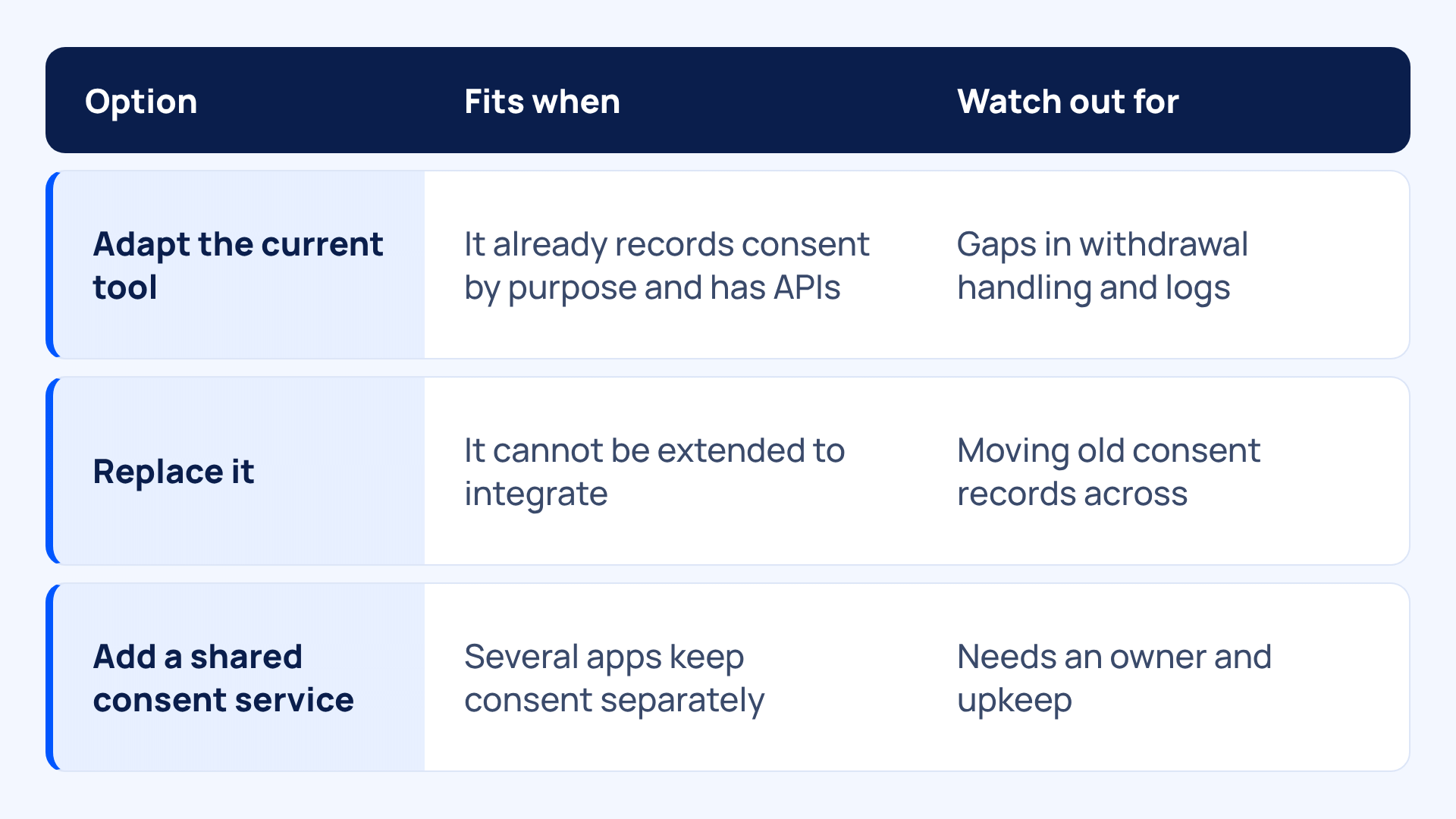
Quick test: pick one customer who appears in three systems and check that a consent change reaches all three records.
3. Does a Withdrawal Reach Every System?
Once a consent decision arrives, every system that uses that data has to act on it. From May 2027, Section 6(4) will let people withdraw consent as easily as they gave it. Section 6(6) will then require the company to stop using the data under that consent, and make its processors stop, within a reasonable time. Other lawful uses can continue.
Tracing One Withdrawal Through Email, Analytics and the Warehouse
Take a customer who withdraws marketing consent in the app. Follow the change to the email platform, the analytics pipeline and the data warehouse. A system that syncs once a night may keep using the data until the next run. Whether that delay is reasonable depends on the use, so decide how the data is blocked meanwhile, and have each system log when it stopped. Building this in from the start is called privacy by design.
Handling AI and Analytics Data After a Withdrawal
Source records, training datasets and live model inputs are different things. The Act does not say whether a model must be retrained or deleted after a withdrawal. Legal and technical teams should check whether personal data is still used on the basis of that consent, then record the decision and the controls behind it.
What May Still Have to Be Kept After Erasure
Section 8(7) will require the company to erase personal data, and make its processors erase it, when consent is withdrawn or the purpose is no longer served, whichever comes first. The exception is data that another law requires it to keep, such as certain security logs. Systems need to tell the two apart.
Quick test: run a withdrawal in a test environment and time how long each system and sync job takes to stop using the data.
4. Who Else Holds the Data?
A withdrawal also has to reach the vendors that hold the same data. A company may handle it well in its own CRM, while a cloud provider, an analytics platform and a support vendor still hold the same customer’s data. Vendors are a big part of the risk, too. Verizon’s 2026 Data Breach Investigations Report found a third party involved in 48% of breaches, up from 30% a year earlier. The law puts that risk on the company as well. From May 2027, Section 8(1) will make the Data Fiduciary responsible for processing done by it, or on its behalf by a Data Processor.
Vendor Contract Terms Beyond Security Safeguards
Rule 6 will require appropriate security safeguards in processor contracts. These points go further, as good practice:
- What the vendor does when a person withdraws consent
- When it must erase data
- How fast it must report an incident
- What evidence the company can ask for
Data Location and Access in Cloud and SaaS Services
Cloud and SaaS providers often work across countries, so ask where data is stored and who can access it. Section 16 lets the Central Government restrict transfers to notified countries or territories. Rule 15 lets it set conditions for foreign States and entities under their control. Data location then becomes one more factor in workload placement decisions.
Quick test: pick the five vendors that hold the most customer data and check that each contract answers the four points above.
5. Can the Company Prove It, and Who Owns It?
Steps one to four only count if there is a record to show for them. This last step covers that record, the safeguards around it and who owns it.
Records to Keep for Each Consent and Withdrawal
From May 2027, Section 6(10) will make the company prove, if asked in a proceeding, that notice was given and consent was taken as the law requires. A log line that says “consent: yes” won’t do that.
- Each consent: customer ID, purpose, notice version shown, date, time, channel and current status
- Each withdrawal: when it arrived and from where, when each system acted, which ones failed, and whether vendors confirmed
Keep these in a log that can be added to but not edited, and keep system clocks in sync so timestamps from different systems agree.
Security Safeguards and the Breach Clock
Section 8(5) will require reasonable security safeguards, and Rule 6 spells out the data security controls.
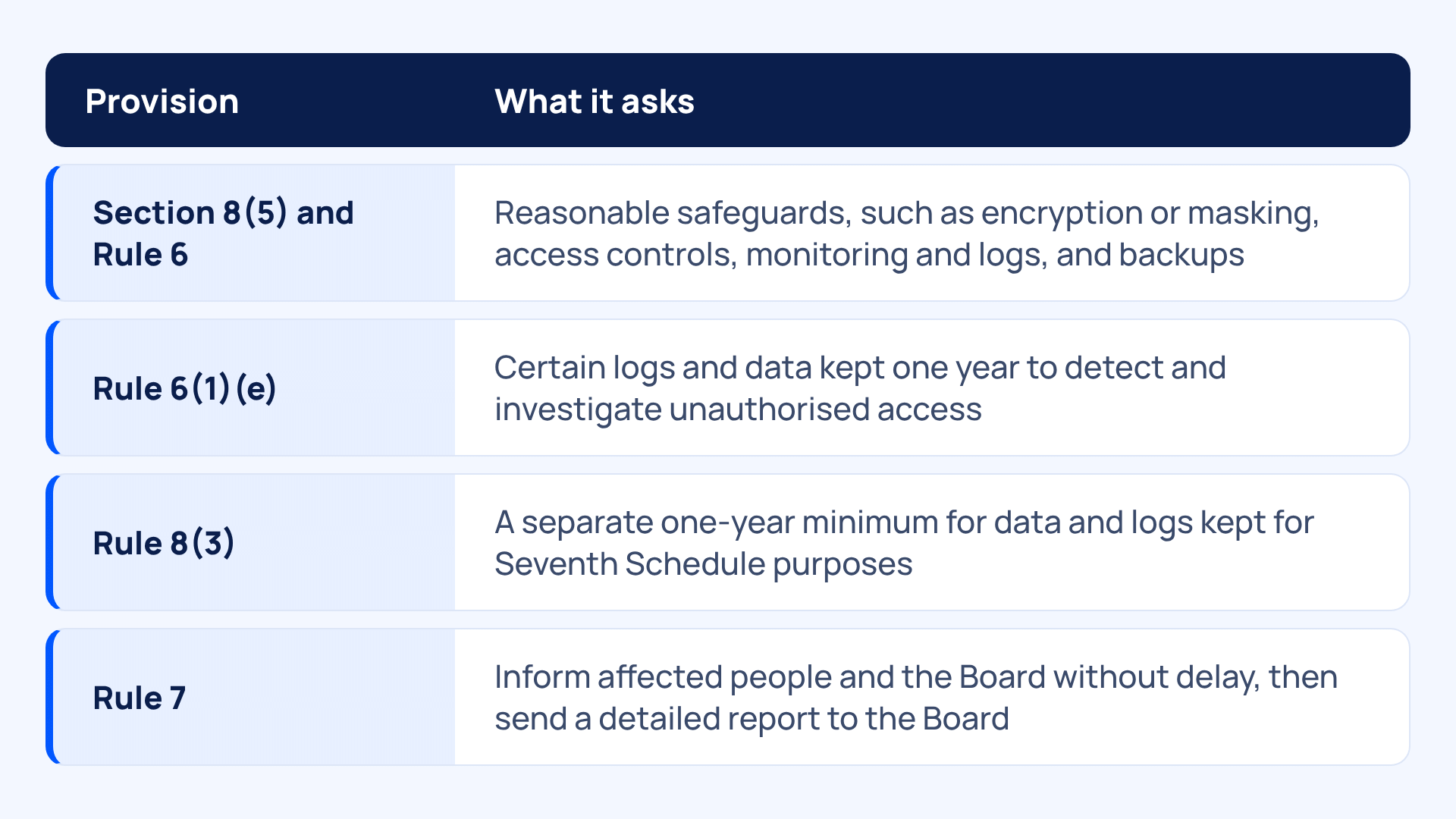
The two one-year rules cover different purposes, so not every log has to be kept for a year. The detailed report is due within 72 hours of becoming aware, unless the Board allows longer, but the first notice can’t wait that long. The Act’s Schedule sets penalty ceilings of up to ₹250 crore for failing to take reasonable safeguards and up to ₹200 crore for failing to notify a breach. Those are maximums.
Control Ownership Across IT, Security and Legal
Every control needs one named owner, or each team assumes another has it. One workable split:
- CIO or IT head: systems and the withdrawal flow
- CISO: safeguards, logs and breach response
- Legal: rules, notice wording and vendor terms
- Business heads: the purpose of each dataset
- Data protection officer, where appointed: tracking gaps
Adapt the split to the company’s structure. A one-page sheet listing each requirement, its system, owner, evidence and last test date works as a simple data protection framework and shows gaps at a glance.
Quick test: pick a consent change from last month and pull the full record: the notice shown, the consent given and what each system did
Six-Month Plan to Get Your Business Ready for DPDP Compliance
Six months goes quickly. A company that waits until spring will be doing its data inventory, consent fixes and vendor changes all at once, with no time left to test. A better order is to finish the inventory and name owners by December, fix the consent and withdrawal flow and update vendor contracts by February, then spend March and April testing withdrawals, running a breach drill and collecting evidence. The five questions in this blog work as a DPDP compliance checklist, and DPDP compliance for businesses starts with the first one: ask each team where customer data sits.
At Progression, we work with enterprise IT teams on infrastructure, cloud and security, so tracing personal data across servers, backups, cloud and vendors is familiar ground for us. Our cybersecurity services cover many of the controls discussed here, including SOC and SIEM monitoring, identity and access management, endpoint protection, and backup and recovery. We can also help review where personal data and consent records sit and where the gaps are before May 2027. Start with the data inventory and talk to our cybersecurity team.
Frequently Asked Questions
- When does DPDP compliance become mandatory for businesses in India?
The main duties for Data Fiduciaries under the DPDP Act are scheduled to start on 13 May 2027. Rule 4, which covers Consent Manager registration, came into force earlier, on 13 November 2026. What applies to a business depends on its role. - Does every business need to register as a Consent Manager?
Only a business that wants to operate as a Consent Manager needs to apply under Rule 4. Most businesses are Data Fiduciaries because they decide why and how personal data is used. A vendor that processes data on their behalf is a Data Processor. - What technical controls do the DPDP Rules require?
Rule 6 requires reasonable security safeguards, including encryption or masking, access controls, logs, monitoring and backups. It also requires security terms in contracts with Data Processors, and certain logs and personal data to be kept for one year. - What happens when someone withdraws consent?
From May 2027, a business will have to stop processing data that relied on the withdrawn consent within a reasonable time, and make its Data Processors stop too. It must also erase the data when consent is withdrawn or the purpose is no longer served, whichever is earlier, unless another law requires it to keep the data. - How can CIOs check whether their DPDP controls work?
CIOs can test the process by withdrawing consent for a test record and checking whether the change reaches every connected system. Then check how quickly vendors act, whether security logs capture the change and whether the evidence can be retrieved.
